


Stress - A Disruption of Vital Energy?
Understanding Energetic Blockages and Pathways to Regeneration
Chronic stress and reduced vitality have become increasingly common in clinical practice. How can the body’s energetic regulatory capacity be strengthened in a sustainable way? We discussed this question with Dr. Birgitt Holschuh-Lorang, MD, General Practitioner and President of the IGPSE.
Dr. Holschuh-Lorang, the term “stress” is used almost inflationarily today. From your clinical experience, what does stress actually do to the organism?
In my practice, stress often presents as a chronic loss of regulatory capacity. Patients come in with exhaustion, sleep disturbances, inner restlessness, difficulty concentrating, or functional complaints such as back pain or cardiac symptoms. In many cases, no sufficient organic cause can be identified.
From a physiological perspective, this usually reflects a persistent overactivation of the sympathetic nervous system. Acute stress responses are adaptive and necessary; the problem arises when the organism can no longer return to a parasympathetic state of recovery. In this situation, homeostasis becomes disrupted.
This raises a crucial question: Why does the system lose its ability to regulate itself? From the perspective of PSE, the underlying cause is a deficiency of vital energy.
What exactly do you mean by a deficiency of vital energy?
PSE expands the psychosomatic model by introducing an energetic level of regulation. Vital energy forms the foundation of autonomic, physical, and psychological regulation. It influences the activity of the autonomic nervous system and, through this pathway, cellular regulation, as well as emotional stability and mental clarity.
Patients suffering from chronic stress almost always show significantly reduced vital and emotional energy levels. They report a lack of drive, diminished resilience, a weakened sense of self, and the sense that they have lost their inner strength.
This energy deficiency is not meant metaphorically — it can be measured.
How do you measure this? Do you use a specific device?
Yes, the RebaPAD. It is used to determine energetic charge at different levels, expressed as a percentage. A healthy and stable individual typically reaches values close to 100 percent. The RebaPad was specifically developed to assess vital, emotional, and mental energy and allows for the differentiated detection of psychoenergetic disturbances caused by energy blockages.
Patients suffering from chronic stress often show vital energy levels between 30 and 50 percent. Emotional energy is frequently even lower, and in some cases mental energy may also be moderately reduced. This differentiation is therapeutically significant, as it provides insight into the extent of the regulatory disturbance.
The measurement also allows us to monitor progress over time. In clinical practice, rising energy levels usually correlate clearly with clinical improvement.
From your perspective, what may be the underlying causes of this energy loss?
The primary cause lies in unconscious conflicts that interfere with energy intake within specific energetic regulatory centers — the chakras. These conflicts act like blockages, disrupting the free absorption and distribution of vital energy.
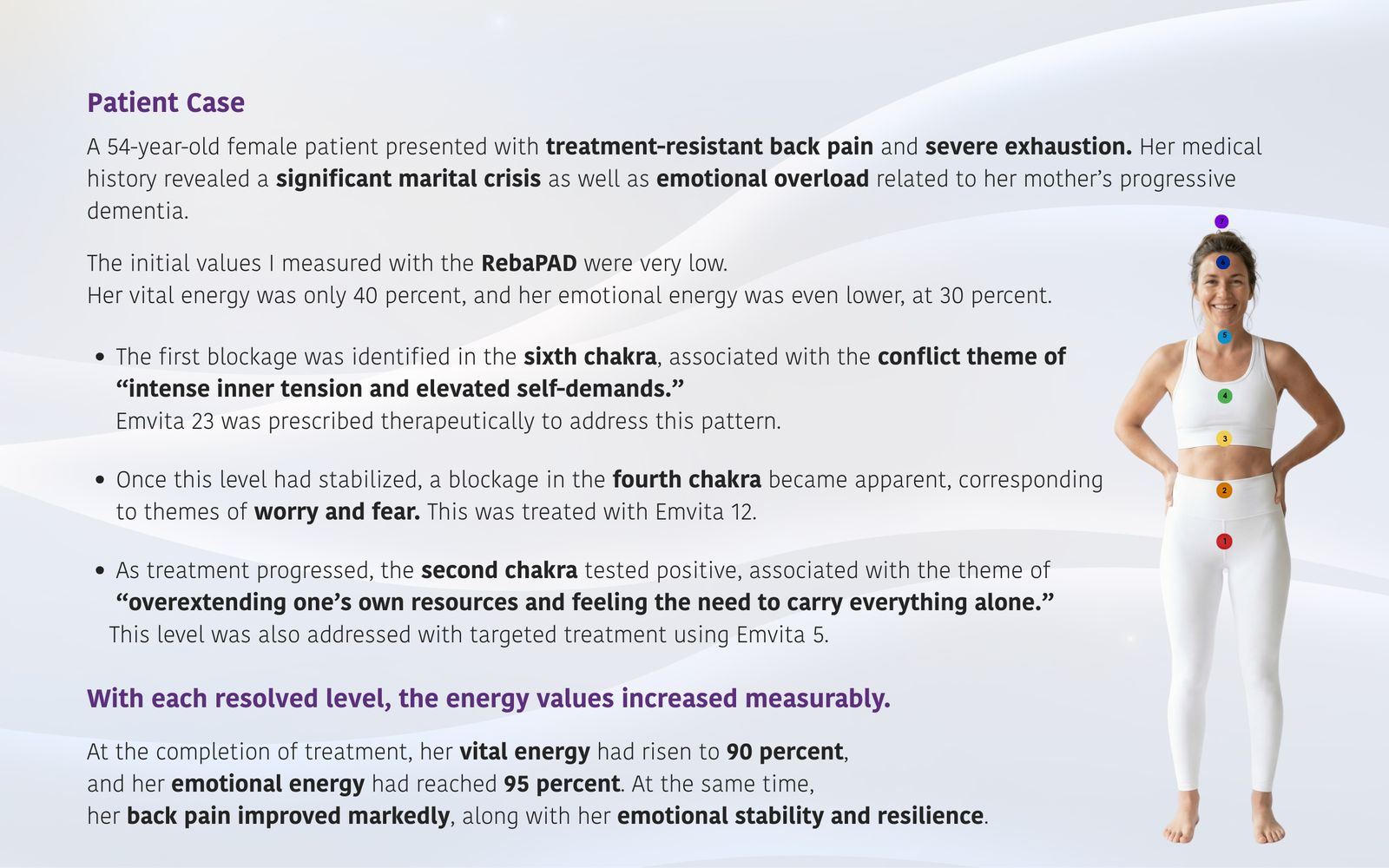
In patients suffering from chronic stress, such blockages are particularly common in three areas. The first is the second chakra, which is closely associated with the stress axis and adrenal function. Here, we often encounter themes such as the constant overexertion of one’s own resources or the perceived need to always remain strong.
In addition, we frequently find blockages in the fourth chakra, which corresponds to worries, fears, and emotional burden. The sixth chakra also plays a central role as a higher-level regulator — it can be understood as a reflection of mental overload and inner tension.
Repressed emotions such as fear, suppressed anger, constant pressure to perform, or the feeling of always having to remain strong continuously bind energy. As a result, this energy is no longer available to the organism for recovery and self-regulation.
I see. So once you have identified an energy deficit using the RebaPad, what happens next?
After testing, the specific blocked chakra is identified, along with the underlying conflict theme that triggers the blockage. Treatment is then initiated using the corresponding Chavita chakra remedy and the individually tested Emvita remedy for conflict resolution. Chavita and Emvita are homeopathic complex remedies specifically developed for PSE to address precisely these identified emotional blockages, such as fears and stress-related patterns.
The remedies are taken over a period of several weeks, with regular retesting. A step-by-step approach is essential. In most cases, we do not find just a single blockage, but rather a chain of conflicts. Once the first level is resolved, the underlying blockage becomes testable.
Alongside the energetic improvement, patients often report emotional clarification, a shift in how they perceive their situation, and a growing sense of empowerment.
What does this look like in practice? Could you illustrate it with a specific case?
One final question: Where do you see the particular strength of PSE in addressing stress?
For me, the strength of PSE lies in its structured diagnostic approach, its clear therapeutic strategy, and the ability to document progress objectively. It integrates psychosomatic understanding with a precise energetic treatment approach.
In addition, PSE allows us to detect energetic regulatory disturbances at an early stage — often before the condition becomes clinically manifest.
Especially in cases of chronic stress, it is not the stressor itself that is decisive, but rather the reduced energetic capacity to process it.
When energy levels are strengthened and underlying conflicts are resolved, resilience increases significantly.
Dr. Holschuh-Lorang, thank you very much for this insightful and engaging conversation.
This interview was conducted in February 2026.